What the Bennu and Ryugu samples teach us about asteroid prospecting
OSIRIS-REx and Hayabusa2 studied two asteroids from orbit, then tested those readings against returned samples. Five lessons for anyone thinking about asteroid resources.
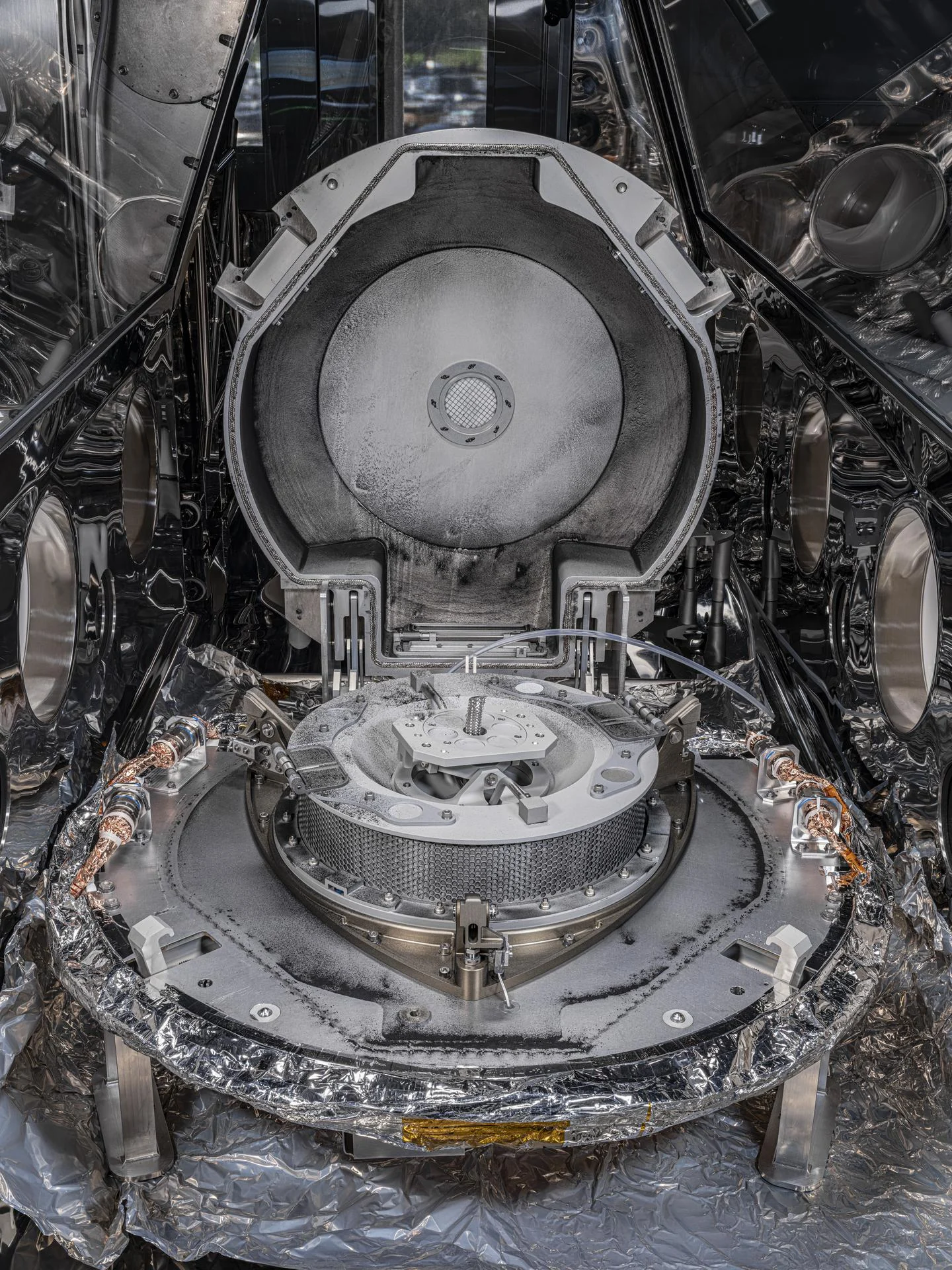
Two spacecraft have brought back material from carbon-rich near-Earth asteroids. JAXA's Hayabusa2 returned grains from Ryugu in 2020, and NASA's OSIRIS-REx returned material from Bennu in 2023. Both missions spent many months studying their targets from orbit before touching them, then tested those remote readings against real samples in the lab.
That sequence is the closest thing we have to a full prospecting test. This article looks at what the remote data got right, where it fell short, and what that means for anyone thinking about asteroid resources. All findings below are the work of the mission teams and the researchers cited.
Two missions, two small samples
Hayabusa2 at Ryugu. JAXA launched Hayabusa2 on 3 December 2014. It touched down on Ryugu on 22 February 2019, used an impactor to make an artificial crater on 5 April 2019, and touched down again on 11 July 2019 to collect material from beneath the surface. The return capsule was recovered in Australia on 6 December 2020 and held about 5.4 grams, against a mission target of 0.1 grams (JAXA).
OSIRIS-REx at Bennu. NASA launched OSIRIS-REx on 8 September 2016. It arrived at Bennu on 3 December 2018 and entered orbit on 31 December 2018, making Bennu the smallest object a spacecraft had orbited. After about a year of mapping, the team selected a sample site called Nightingale on 12 December 2019, inside a crater about 140 meters wide and surrounded by hazardous boulders. The spacecraft touched the surface on 20 October 2020, and its capsule landed in Utah on 24 September 2023 (NASA). NASA announced a total of 121.6 grams in February 2024, more than twice the mission requirement (NASA). That requirement was at least 60 grams (Walsh et al. 2022).
Lesson 1: orbital spectroscopy identified the right kind of material
From orbit, OSIRIS-REx's visible and infrared spectrometer (OVIRS, 0.4 to 4.3 micrometers) and thermal emission spectrometer (OTES, about 5.71 to 100 micrometers) found an absorption feature near 2.7 micrometers across Bennu's surface. That feature indicates hydrated minerals, and the spectra resembled aqueously altered CM carbonaceous chondrite meteorites (Hamilton et al. 2019).
The returned sample confirmed this. The preliminary analysis found that the minerals detected remotely were all present: hydrated phyllosilicates (clays), magnetite, organic matter, carbonates, and scarce anhydrous silicates (Lauretta et al. 2024).
For prospecting, this is the encouraging result. Remote spectroscopy, done carefully from close range, correctly identified the broad mineral makeup of a target before anyone touched it.
Lesson 2: samples reveal what remote data cannot
The same sample also contained material the orbital data had not identified. Lauretta and colleagues report iron and nickel sulfides including pyrrhotite and pentlandite, presolar grains, and magnesium and sodium-rich phosphates that the team did not expect (Lauretta et al. 2024). Later studies identified 11 evaporite minerals, from calcite to halite and sylvite, which form as water evaporates (NASA, January 2025).
Ryugu shows the same pattern in a different way. From orbit, Hayabusa2's near-infrared spectrometer found a weak, narrow absorption at 2.72 micrometers across the whole surface. Its strength resembled carbonaceous chondrites that had been heated or shocked (Kitazato et al. 2019). In the lab, the returned grains turned out to be most similar to CI chondrites, a class altered by water, but more pristine than any CI meteorite on Earth (Yokoyama et al. 2022).
Remote sensing measures a thin outer layer that sunlight, solar wind, and heating can change. A sample shows the material underneath. The two together tell a more complete story than either alone.
Lesson 3: quantities are hard to predict
Before the capsule was opened, spacecraft data suggested OSIRIS-REx had collected about 250 grams, with an uncertainty of plus or minus 101 grams. The measured total was 121.6 grams (Lauretta et al. 2024). Access was also harder than planned. Two stuck fasteners on the sampler head delayed full access to the material until they were removed on 11 January 2024 (NASA).
Both points matter for resource thinking. Estimates of how much material a system gathered, and how easily it can be handled afterward, carry real uncertainty even for a well-instrumented mission.
Lesson 4: surfaces can be extremely weak
OSIRIS-REx touched Bennu at about 10 centimeters per second, fired its gas bottle about one second after contact, and backed away after about six seconds. Analysis of how the surface responded found that the material near the surface behaved like a loose granular bed with almost no cohesion, about half as dense as the asteroid as a whole (Walsh et al. 2022). The authors estimate a compressive strength of 2 to 200 pascals and cohesion of roughly 0.2 to 20 pascals. Bennu, about 500 meters across, has a bulk density of 1,190 kilograms per cubic meter. At Ryugu, the artificial impact experiment implied an effective surface strength below 1.3 pascals (Walsh et al. 2022).
Any equipment designed to anchor to, scoop, or move material on rubble-pile asteroids like these has to work in conditions closer to loose sand in microgravity than to solid rock.
Lesson 5: composition is close to the Sun's
Bulk chemistry matters most for anyone asking about metals and rare earth elements. The Bennu sample is rich in water-bearing minerals, with 0.84 to 0.95% hydrogen by weight, and in carbon, with 4.5 to 4.7% carbon by weight. Its overall elemental abundances are similar to the Sun's composition (Lauretta et al. 2024). Ryugu's grains are an even closer match to the solar photosphere than other natural samples (Yokoyama et al. 2022).
A solar-like bulk composition means these two asteroids show no sign of being enriched in any particular rare or strategic metal. For carbon-rich asteroids, the more realistic near-term resources are water, carbon, and volatiles. For metals, the question becomes whether other asteroid types, or specific mineral phases such as the sulfides and magnetite found in Bennu, concentrate useful elements. That is a question for future measurement, not a conclusion these samples support.
What this means for survey-first prospecting
Taken together, the two missions suggest a sensible order of work:
- Survey from close range first. Months of mapping and spectroscopy identified Bennu's broad mineral makeup correctly and found a safe place to sample.
- Expect gaps in remote data. Surface spectra can miss minerals or reflect a weathered outer layer.
- Validate with small samples. A few grams from Ryugu and about 120 grams from Bennu have supported years of laboratory analysis.
- Design for weak, loose surfaces. Near-zero cohesion changes how any later operation must work.
Near Earth AI is an early-stage research and development company. We are studying results like these to develop concepts for survey-first prospecting, in which remote characterization comes before any sampling. We have not surveyed, sampled, or analyzed any asteroid ourselves. The findings above belong to the NASA and JAXA mission teams and the researchers cited.
Sources
- JAXA, Asteroid Explorer Hayabusa2, accessed 21 October 2026.
- NASA, OSIRIS-REx mission page, accessed 21 October 2026.
- K. J. Walsh et al., Near-zero cohesion and loose packing of Bennu's near subsurface revealed by spacecraft contact, Science Advances 8 (2022).
- V. E. Hamilton et al., Evidence for widespread hydrated minerals on asteroid (101955) Bennu, Nature Astronomy 3 (2019).
- D. S. Lauretta et al., Asteroid (101955) Bennu in the laboratory: Properties of the sample collected by OSIRIS-REx, Meteoritics and Planetary Science (2024).
- NASA, NASA's Asteroid Bennu Sample Reveals Mix of Life's Ingredients, 29 January 2025.
- K. Kitazato et al., The surface composition of asteroid 162173 Ryugu from Hayabusa2 near-infrared spectroscopy, Science 364 (2019).
- T. Yokoyama et al., Samples returned from the asteroid Ryugu are similar to Ivuna-type carbonaceous meteorites, Science (2022).