What are asteroids made of?
What are asteroids made of? Rock, clay, carbon, and metal. A sourced guide to asteroid composition from NASA and JAXA missions and returned samples.
What are asteroids made of? Mostly rock, metal, and carbon-rich material left over from the formation of the solar system about 4.6 billion years ago (JAXA ISAS). NASA groups them into three broad types: dark C-types that probably consist of clay and silicate rock, stony S-types made of silicate minerals and nickel-iron, and metallic M-types made of nickel-iron (NASA). Samples returned from three asteroids have confirmed much of this, and added detail no telescope could see.
This article explains what asteroids are made of, how scientists know, and where the answer is still uncertain. Every figure links to its source.
Asteroid composition by type
Asteroid composition is usually described by spectral type, a label based on how an asteroid reflects sunlight at different wavelengths and how bright it is. NASA's summary uses three broad groups (NASA):
| Type | What it is made of (NASA summary) | Sampled or visited example |
|---|---|---|
| C-type (chondrite) | Probably clay and silicate rocks; dark | Ryugu, sampled by Hayabusa2 |
| S-type (stony) | Silicate materials and nickel-iron | Itokawa, sampled by Hayabusa |
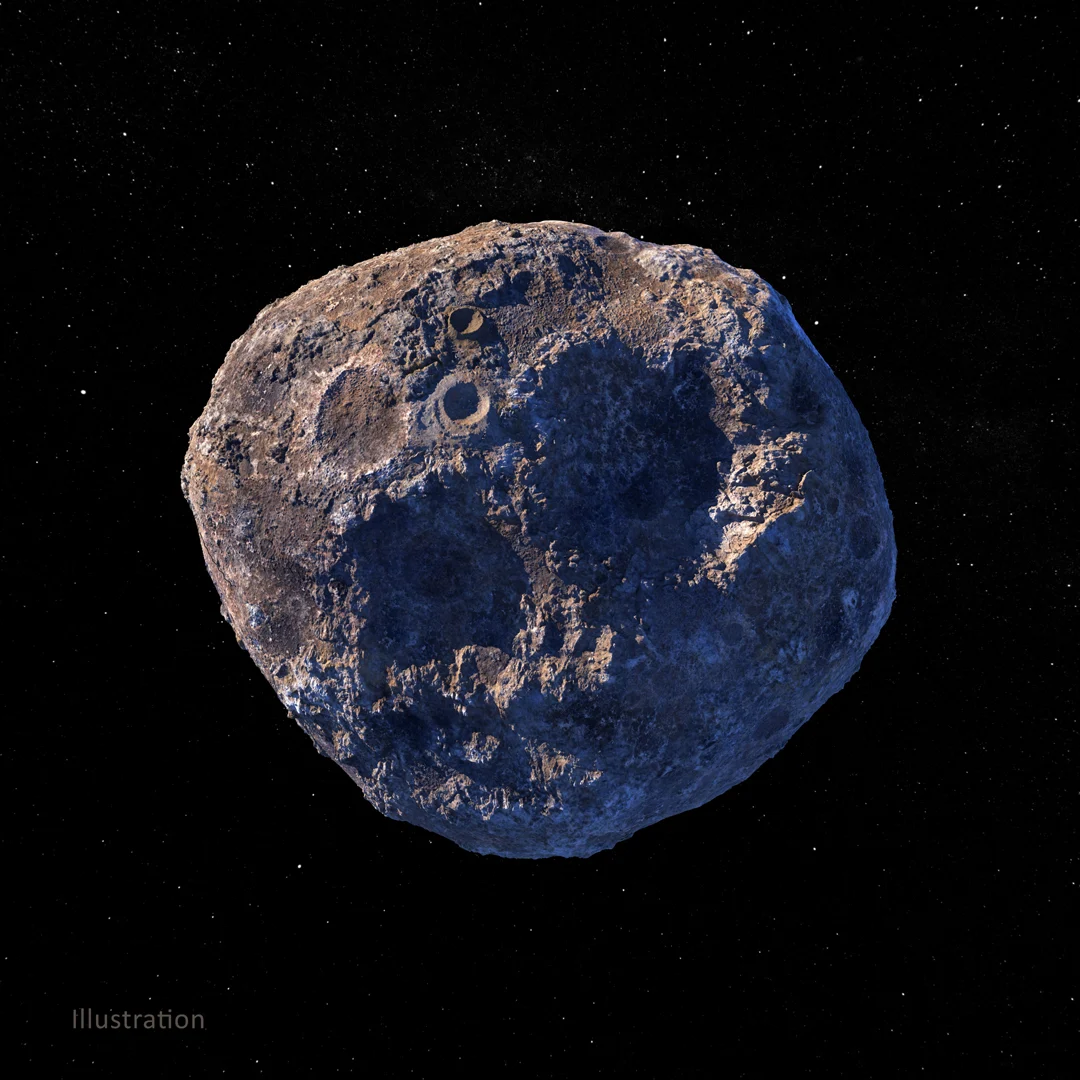
| M-type (metallic) | Nickel-iron | Psyche, a main-belt target of NASA's Psyche mission |
NASA describes C-types as the most common and among the most ancient objects in the solar system. It explains that the differences between types relate to how far from the Sun each asteroid formed. Some asteroids heated up and partly melted after they formed, so iron sank to the center and basaltic lava rose to the surface (NASA).
Researchers use finer systems than these three letters. The Bus-DeMeo taxonomy, for example, defines 24 classes from spectra spanning 0.45 to 2.45 micrometers (DeMeo et al. 2009). Our article on types of asteroids covers those systems in more detail.
How scientists know what asteroids are made of
There are three main lines of evidence. Each has strengths and blind spots.
1. Spectra from telescopes and spacecraft
Minerals absorb light at characteristic wavelengths. In the near-infrared, absorption features near 1 and 2 micrometers come mainly from olivine and pyroxene, two common silicate minerals (DeMeo et al. 2009). Water-bearing minerals produce a feature near 2.7 micrometers, which OSIRIS-REx detected across asteroid Bennu from orbit (Hamilton et al. 2019).
Spectra only describe the outer surface. Sunlight, solar wind, and heating can alter that layer, so remote readings need checking against real samples. Our article on remote sensing and survey-first prospecting goes deeper on this.
2. Meteorites
Meteorites are pieces of asteroids that reached Earth. Laboratories can analyze them in full detail, but linking a meteorite to its parent asteroid is hard. Two links are now well established:
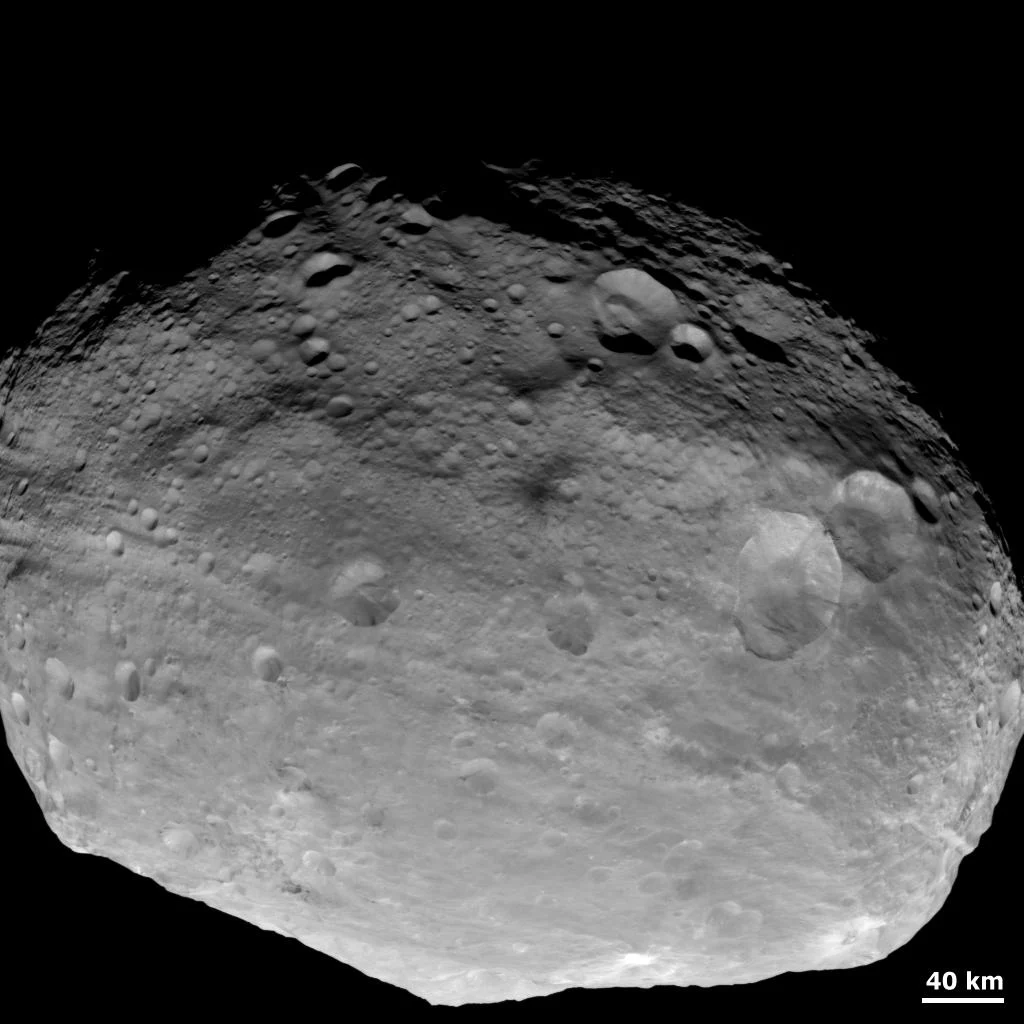
- Vesta and the HED meteorites. NASA's Dawn spacecraft orbited Vesta and found that its surface mineralogy matches the howardite, eucrite, and diogenite (HED) meteorites. Dawn's data show Vesta has an iron core with an average radius of 107 to 113 kilometers, which confirms that it melted and separated into layers (Russell et al. 2012). The HED group includes more than 1,000 named samples (McSween et al. 2013).
- S-types and ordinary chondrites. Dust that JAXA's first Hayabusa mission returned from Itokawa matched thermally metamorphosed LL chondrites. The study concluded that ordinary chondrites, the most abundant meteorites found on Earth, come from S-type asteroids (Nakamura et al. 2011).
Iron meteorites tell another part of the story. McSween and colleagues note that the many groups of iron meteorites suggest differentiated asteroids were common in the early solar system, even though in most cases only their metal cores survived (McSween et al. 2013).
3. Sample return
Sample return gives direct ground truth from a known asteroid. Three asteroids have now been sampled:
- Itokawa (S-type), by JAXA's Hayabusa. The particles were identical in mineralogy to LL chondrites, consistent with what spectra from Earth and from the spacecraft had suggested (Nakamura et al. 2011).
- Ryugu (C-type), by JAXA's Hayabusa2, which returned about 5.4 grams in 2020 (JAXA).
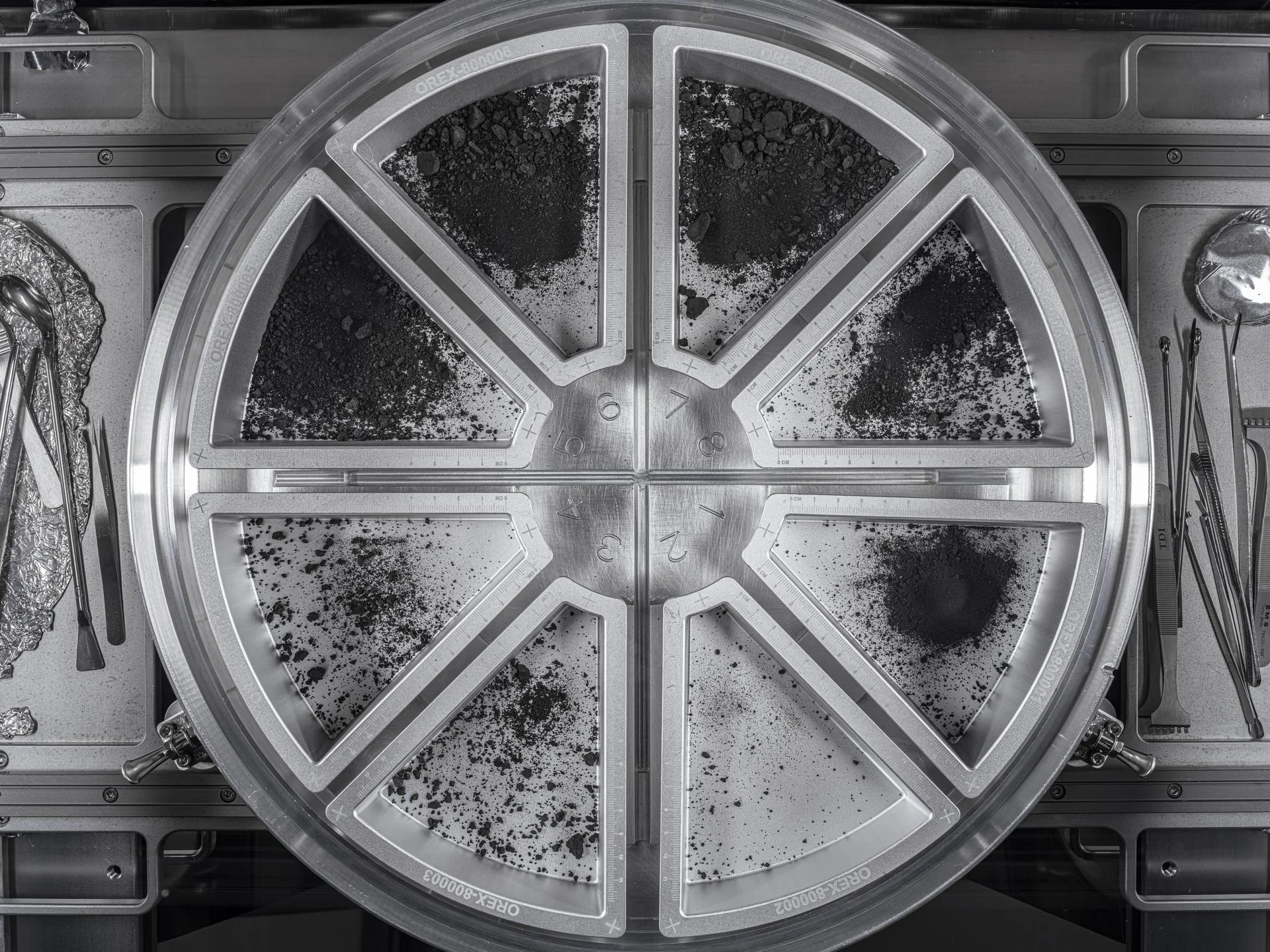
- Bennu (carbon-rich), by NASA's OSIRIS-REx, which returned 121.6 grams in 2023 (NASA).
What the Bennu and Ryugu samples confirmed
The Bennu sample confirmed every mineral group that OSIRIS-REx had detected from orbit: water-bearing clay minerals (phyllosilicates), magnetite, organic matter, carbonates, and scarce anhydrous silicates. It also contained iron and nickel sulfides, including pyrrhotite and pentlandite, plus presolar grains and unexpected magnesium and sodium-rich phosphates (Lauretta et al. 2024).
By weight, the Bennu material contains 0.84 to 0.95% hydrogen and 4.5 to 4.7% carbon, and its overall elemental abundances are similar to the Sun's composition (Lauretta et al. 2024). Later studies reported 14 of the 20 amino acids that life on Earth uses to make proteins, all five nucleobases, and 11 minerals that form as salty water evaporates. NASA notes that these are building blocks, not evidence of life (NASA, January 2025).
Ryugu's grains are most similar to CI chondrites, a rare class of meteorite altered by water, but more pristine than CI meteorites found on Earth. They are the closest match to the composition of the Sun's visible surface of any natural sample measured (Yokoyama et al. 2022). From orbit, Ryugu's spectra had resembled meteorites that were heated or shocked (Kitazato et al. 2019), a reminder that surface readings can differ from what lies in the grains.
We cover these missions in more detail in what the Bennu and Ryugu samples teach us.
Where the answer is still uncertain
Most asteroids have no measured composition. The JPL Small-Body Database lists a spectral class for only 327 of 42,794 known near-Earth asteroids (JPL SBDB). We walk through those numbers in how many near-Earth asteroids are there.
"Metallic" is not always metallic. M-type is a spectral label, not a confirmed composition. In a study of 27 M-class asteroids, more than 35% showed a 3 micrometer absorption that indicates water-bearing minerals, which does not fit pure iron-nickel metal (Rivkin et al. 2000). Even Psyche, the best-known M-type, is now estimated to be a mix of rock and metal, with metal making up 30% to 60% of its volume (NASA). NASA's Psyche spacecraft, launched in October 2023, is scheduled to begin its prime mission there in August 2029 (NASA).
Bulk composition is not concentration. Bennu's solar-like bulk chemistry means it shows no sign of being enriched in any particular rare metal (Lauretta et al. 2024). Whether any asteroid holds useful concentrations of specific elements is a question for future measurement.
Where Near Earth AI stands
Near Earth AI is an early-stage research and development company. We are researching how survey-first prospecting could work, in which remote characterization comes before any sampling. We have not found, surveyed, ranked, or sampled any asteroid. Everything reported above is the work of NASA, JAXA, and the researchers cited.
FAQ
What are most asteroids made of?
NASA describes C-type asteroids, which probably consist of clay and silicate rock, as the most common type (NASA). Stony S-types and metallic M-types make up other major groups.
Are asteroids made of gold or platinum?
The asteroids sampled so far are stony or carbon-rich, not metallic. The Bennu sample has bulk elemental abundances similar to the Sun's, with no sign of precious-metal enrichment (Lauretta et al. 2024). Metal-rich asteroids may hold more of such elements, but none has been sampled yet.
Do asteroids contain water?
Many carbon-rich asteroids hold water locked inside minerals rather than as ice. The Bennu sample contains 0.84 to 0.95% hydrogen by weight, mostly in water-bearing clay minerals (Lauretta et al. 2024).
How do scientists know what an asteroid is made of without visiting it?
They compare its reflected light (its spectrum) and brightness with lab measurements of minerals and meteorites. Sample-return missions then test those readings, as Hayabusa did at Itokawa (Nakamura et al. 2011).
Sources
- NASA, Asteroid Facts, accessed 21 October 2026.
- JAXA ISAS, Asteroid Explorer Hayabusa2, accessed 21 October 2026.
- F. E. DeMeo et al., An extension of the Bus asteroid taxonomy into the near-infrared, Icarus 202 (2009).
- V. E. Hamilton et al., Evidence for widespread hydrated minerals on asteroid (101955) Bennu, Nature Astronomy 3 (2019).
- C. T. Russell et al., Dawn at Vesta: Testing the protoplanetary paradigm, Science 336 (2012).
- H. Y. McSween et al., Dawn; the Vesta-HED connection; and the geologic context for eucrites, diogenites, and howardites, Meteoritics and Planetary Science (2013).
- T. Nakamura et al., Itokawa dust particles: A direct link between S-type asteroids and ordinary chondrites, Science 333 (2011).
- JAXA, Asteroid Explorer Hayabusa2, accessed 21 October 2026.
- NASA, OSIRIS-REx mission page, accessed 21 October 2026.
- D. S. Lauretta et al., Asteroid (101955) Bennu in the laboratory: Properties of the sample collected by OSIRIS-REx, Meteoritics and Planetary Science (2024).
- NASA, NASA's Asteroid Bennu Sample Reveals Mix of Life's Ingredients, 29 January 2025.
- T. Yokoyama et al., Samples returned from the asteroid Ryugu are similar to Ivuna-type carbonaceous meteorites, Science (2022).
- K. Kitazato et al., The surface composition of asteroid 162173 Ryugu from Hayabusa2 near-infrared spectroscopy, Science 364 (2019).
- NASA JPL, Small-Body Database Query API, queried 21 October 2026.
- A. S. Rivkin et al., The nature of M-class asteroids from 3-micron observations, Icarus 145 (2000).
- NASA, Asteroid Psyche and Psyche mission overview, accessed 21 October 2026.