Types of asteroids explained: C, S and M, and what each could offer
Types of asteroids explained: how scientists classify C-type, S-type, and M-type asteroids, with Ryugu, Itokawa, Psyche, and Vesta as sourced examples.
Astronomers sort asteroids into types by how they reflect sunlight. The three you will see most often are C-type (dark and carbon-rich), S-type (stony), and M-type (thought to be metallic). These types of asteroids are useful shorthand, but each label describes a surface spectrum, not a confirmed composition.
This article explains how asteroid classification works at a plain level, gives a real example of each major type, and says carefully what each type could offer as a resource. Every figure links to its source.
How asteroid classification works
An asteroid's spectrum is the pattern of sunlight it reflects across different wavelengths. Minerals absorb light at characteristic wavelengths, so the shape of the spectrum carries clues about the surface. Brightness, or albedo, adds another clue.
The earliest classification schemes used broad-band colors and already separated two groups labeled S and C (DeMeo et al. 2009). Two later systems are still widely used.
The Tholen system (1984)
David Tholen built his taxonomy from the Eight-Color Asteroid Survey, which measured brightness through eight filters between about 0.3 and 1.1 micrometers, combined with albedo from thermal measurements. He recognized seven major classes, labeled A, C, D, E, M, P, and S, plus minor classes B, F, and G. Three unusual asteroids got their own letters, including V for 4 Vesta (Tholen 1984).
One detail matters for metal. Tholen's E, M, and P classes all have featureless visible spectra and are told apart only by albedo: high for E, moderate for M, and low for P. Without albedo data, such an asteroid is simply labeled X (Hardersen et al. 2011). So "M-type" means "featureless spectrum with moderate brightness", not "proven metal".
The Bus-DeMeo system (2009)
The Bus-DeMeo taxonomy extends classification into the near-infrared, using spectra from 0.45 to 2.45 micrometers. That range includes absorption features near 1 and 2 micrometers caused mainly by the silicate minerals olivine and pyroxene. It defines 24 classes grouped into broader complexes, and it keeps its letters consistent with the earlier Bus and Tholen systems (DeMeo et al. 2009). In this system, Tholen's featureless E, M, and P asteroids fall into the X-complex. A 2022 taxonomy reintroduced albedo specifically to split that complex back into E, M, and P (Mahlke et al. 2022).
The main types of asteroids at a glance
| Type | NASA's description | Example | How we know the example |
|---|---|---|---|
| C-type | Probably clay and silicate rocks; dark | Ryugu | Samples returned by Hayabusa2 |
| S-type | Silicate materials and nickel-iron | Itokawa | Samples returned by Hayabusa |
| M-type | Metallic (nickel-iron) | Psyche | Radar, thermal and density data; spacecraft arriving 2029 |
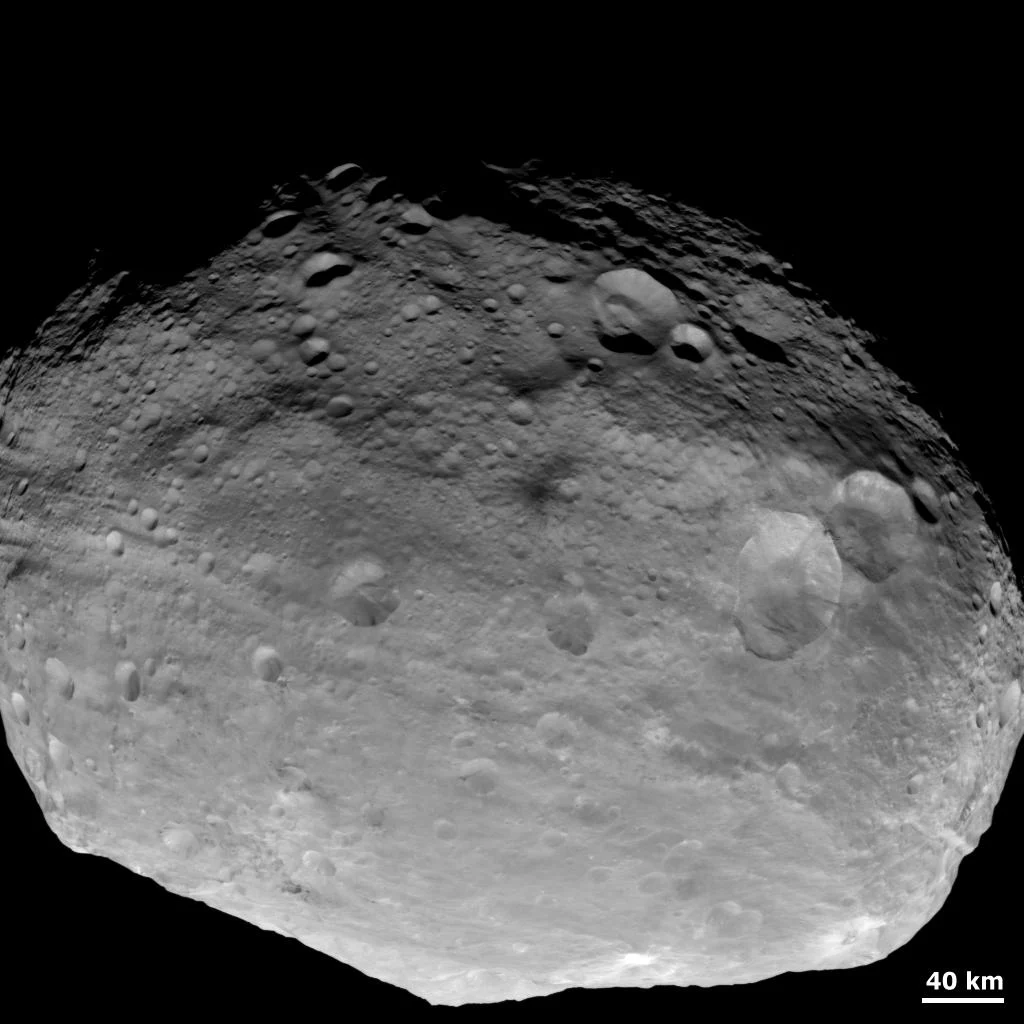
| V-type | Basaltic crust (Vesta-like) | Vesta | Dawn orbiter and HED meteorites |
NASA descriptions are from its asteroid facts page. Example sources are cited in each section below.
C-type asteroids
NASA describes C-type (chondrite) asteroids as the most common type. They are dark, probably consist of clay and silicate rocks, and are among the most ancient objects in the solar system (NASA).
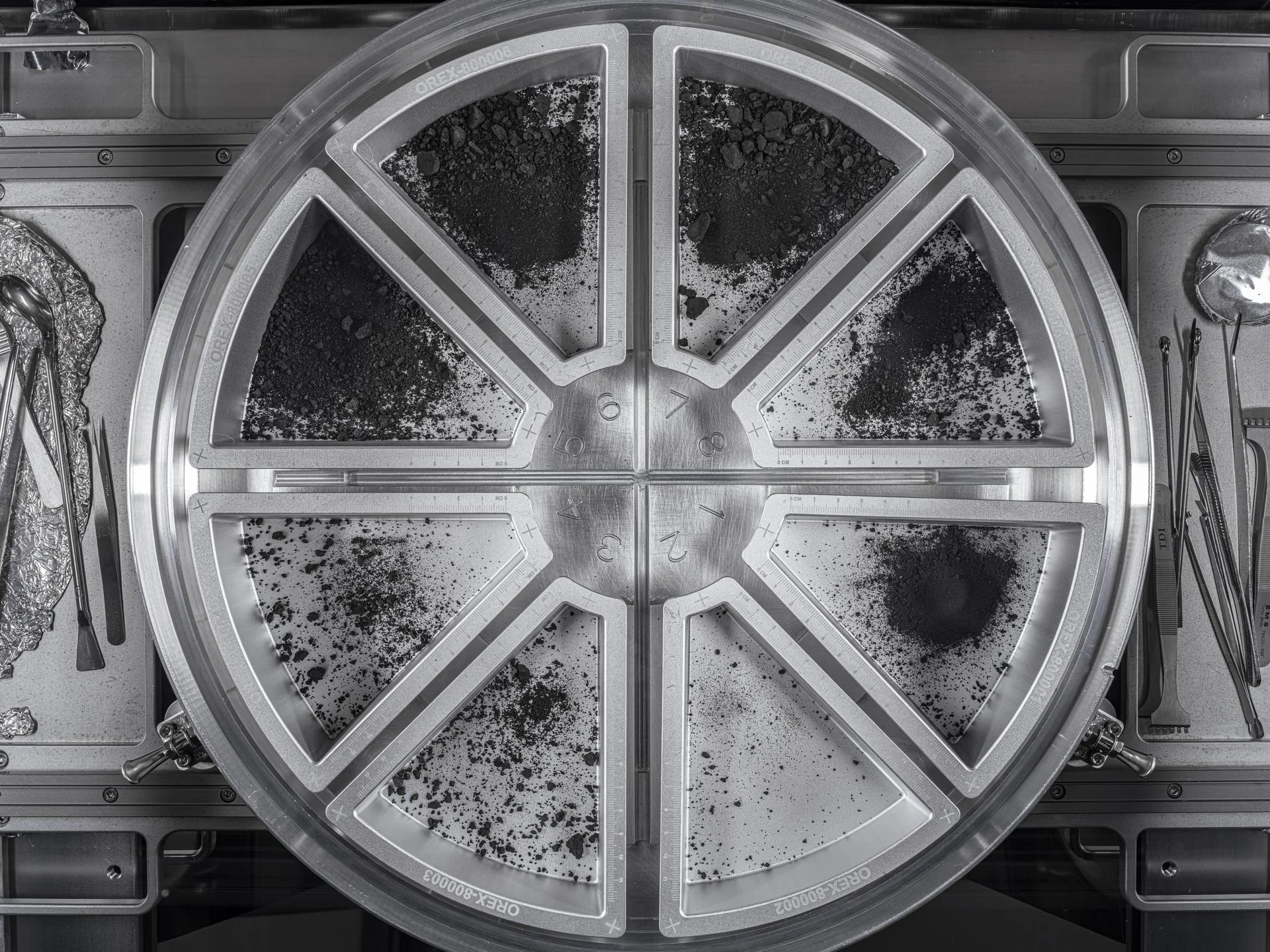
Example: Ryugu. JAXA's Hayabusa2 explored Ryugu, which JAXA classifies as type C, and returned about 5.4 grams of material in December 2020 (JAXA). The grains are most similar to CI chondrites, a meteorite class altered by water, and more pristine than CI meteorites found on Earth (Yokoyama et al. 2022). NASA's OSIRIS-REx sampled Bennu, another dark carbon-rich asteroid, and found 0.84 to 0.95% hydrogen and 4.5 to 4.7% carbon by weight in the returned material (Lauretta et al. 2024).
What C-types could offer. The returned samples show water-bearing minerals, carbon, and organic compounds. Those are the most discussed candidate resources for use in space, for example as a source of water. Their bulk composition is close to the Sun's, so they show no sign of enrichment in rare metals (Lauretta et al. 2024).
S-type asteroids
NASA describes S-type, or stony, asteroids as made of silicate materials and nickel-iron (NASA). Tholen noted that most Earth-approaching asteroids in his 1984 data set were class S (Tholen 1984). That reflects which asteroids had been observed, since bright stony objects are easier to measure. It is not a census of the whole population.
Example: Itokawa. JAXA's first Hayabusa mission returned dust from Itokawa, an S-type asteroid (JAXA ISAS). The particles matched thermally metamorphosed LL chondrites. The study concluded that ordinary chondrites, the most abundant meteorites found on Earth, come from S-type asteroids (Nakamura et al. 2011).
Coming next: Apophis. NASA's OSIRIS-APEX is scheduled to reach the stony asteroid Apophis in June 2029, shortly after its close pass by Earth. It will fire its thrusters near the surface to stir up loose material and see what lies just below (NASA).
What S-types could offer. S-type asteroids contain silicate rock and some metallic nickel-iron. How much metal, and in what form, varies and needs direct measurement.
M-type asteroids
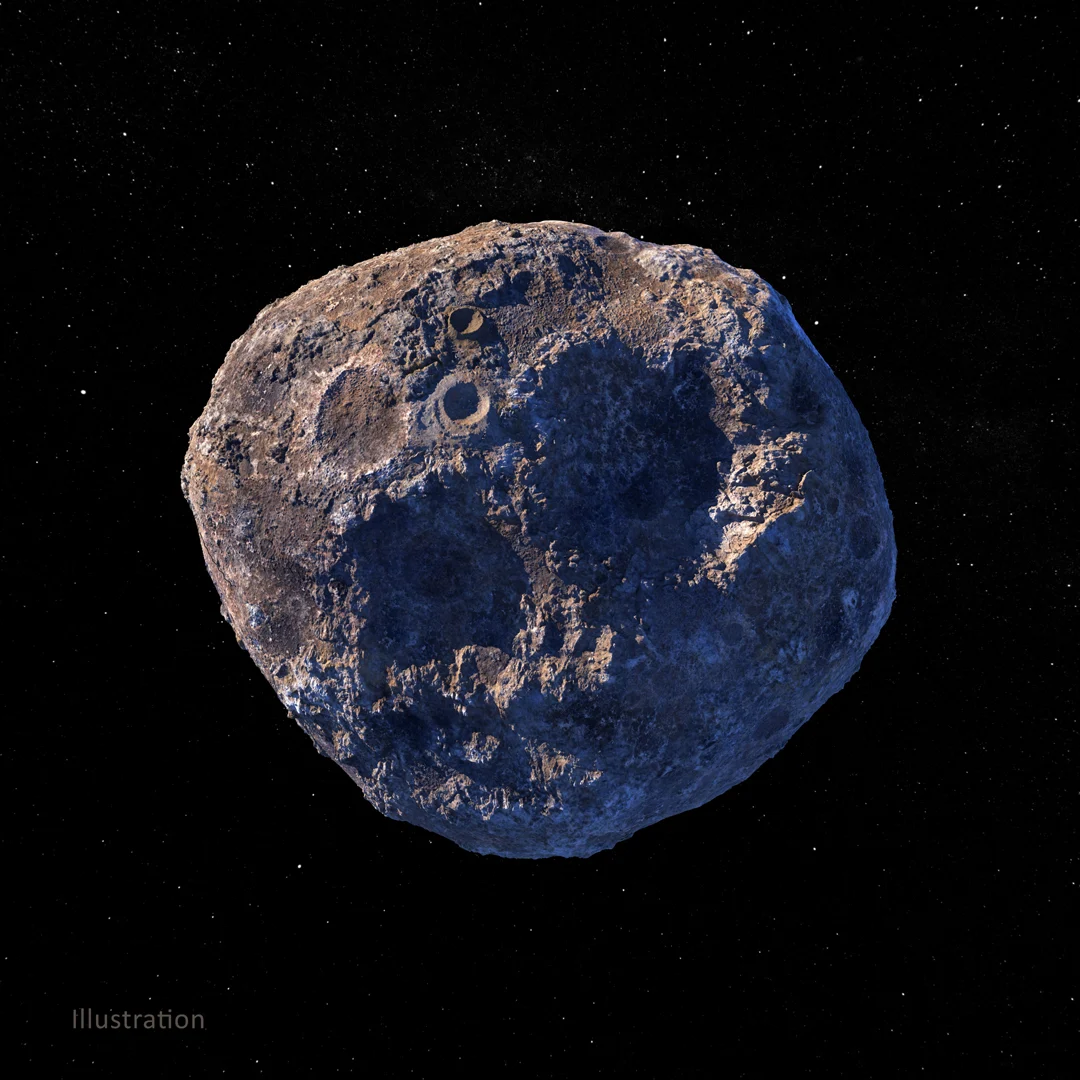
NASA describes M-types as metallic, made of nickel-iron (NASA). One idea is that some are the exposed cores of early bodies that melted, with iron sinking to the center. NASA's Psyche mission is designed in part to test that idea (NASA). The evidence so far is mixed.
Example: Psyche. Psyche is a main-belt asteroid about 280 kilometers across at its widest point. NASA's current estimate is that it is a mix of rock and metal, with metal making up 30% to 60% of its volume, based on radar observations and thermal inertia (NASA). Its estimated density is 3,400 to 4,100 kilograms per cubic meter (NASA JPL). NASA's Psyche spacecraft launched on 13 October 2023 and is scheduled to begin its prime mission there in August 2029 (NASA).
Why "metallic" needs caution. In a study of 27 M-class asteroids, more than 35% showed an absorption at 3 micrometers that indicates water-bearing minerals, which does not fit pure iron-nickel metal. The authors suggested that large M-class asteroids may be more primitive material, with iron meteorites more likely coming from smaller, dry M-types (Rivkin et al. 2000). A near-infrared survey of 45 M- and X-class asteroids found mineral absorption features in 60% of them (Hardersen et al. 2011).
What M-types could offer. If an M-type is truly metal-rich, it could hold iron, nickel, and other metals. Confirming that requires close-up measurements, which is what NASA's Psyche mission is designed to make (NASA). Our article on survey-first remote sensing explains how orbiting instruments measure composition.
V-type asteroids and Vesta
Vesta is unusual enough that Tholen gave it its own class, V (Tholen 1984). NASA's Dawn mission confirmed that Vesta melted and formed an iron core, and that it is the source of the howardite, eucrite, and diogenite (HED) meteorites (Russell et al. 2012). Vesta shows what a layered asteroid looks like from the outside: a basaltic crust over a mantle and core.
What types can and cannot tell you
A spectral type is a starting hypothesis about composition. It cannot tell you how concentrated a specific element is, what lies below the surface, or how much material is accessible. Most near-Earth asteroids do not even have a type yet. The JPL Small-Body Database lists a spectral class for only 327 of 42,794 known near-Earth asteroids (JPL SBDB), as covered in how many near-Earth asteroids are there.
For a fuller answer on minerals and samples, see what are asteroids made of.
Where Near Earth AI stands
Near Earth AI is an early-stage research and development company. We are researching how survey-first prospecting could work, including how spectral types and other remote data might feed into target ranking as a concept. We have not found, surveyed, ranked, or sampled any asteroid. The classifications and missions above are the work of the researchers and agencies cited.
FAQ
What are the three main types of asteroids?
NASA's broad grouping is C-type, S-type, and M-type: dark carbon-rich, stony, and metallic (NASA). Research taxonomies such as Bus-DeMeo use 24 classes (DeMeo et al. 2009).
What is a C-type asteroid?
A dark asteroid that NASA says probably consists of clay and silicate rocks (NASA). Ryugu is a sampled example (JAXA).
What is an M-type asteroid?
An asteroid with a featureless visible spectrum and moderate albedo, often interpreted as metallic (Hardersen et al. 2011). Some M-types show signs of water-bearing minerals, so not all are metal (Rivkin et al. 2000).
Which type of asteroid is best for mining?
No one knows yet. C-types may offer water and carbon, and M-types may offer metals, but no metallic asteroid has been sampled. NASA describes Psyche as its first mission to study an asteroid with more metal than rock or ice (NASA). See is asteroid mining possible yet.
Sources
- F. E. DeMeo et al., An extension of the Bus asteroid taxonomy into the near-infrared, Icarus 202 (2009).
- D. J. Tholen, Asteroid taxonomy from cluster analysis of photometry, PhD dissertation, University of Arizona (1984).
- P. S. Hardersen et al., The M-/X-asteroid menagerie: Results of an NIR spectral survey of 45 main-belt asteroids, Meteoritics and Planetary Science (2011).
- M. Mahlke, B. Carry, P.-A. Mattei, Asteroid taxonomy from cluster analysis of spectrometry and albedo, Astronomy and Astrophysics (2022).
- NASA, Asteroid Facts, accessed 21 October 2026.
- JAXA, Asteroid Explorer Hayabusa2 and JAXA ISAS, Hayabusa2 mission page, accessed 21 October 2026.
- T. Yokoyama et al., Samples returned from the asteroid Ryugu are similar to Ivuna-type carbonaceous meteorites, Science (2022).
- D. S. Lauretta et al., Asteroid (101955) Bennu in the laboratory, Meteoritics and Planetary Science (2024).
- T. Nakamura et al., Itokawa dust particles: A direct link between S-type asteroids and ordinary chondrites, Science 333 (2011).
- NASA, OSIRIS-APEX mission page, accessed 21 October 2026.
- NASA, Asteroid Psyche and Psyche mission overview, accessed 21 October 2026.
- NASA JPL, Psyche press kit: Science, accessed 21 October 2026.
- A. S. Rivkin et al., The nature of M-class asteroids from 3-micron observations, Icarus 145 (2000).
- C. T. Russell et al., Dawn at Vesta: Testing the protoplanetary paradigm, Science 336 (2012).
- NASA JPL, Small-Body Database Query API, queried 21 October 2026.